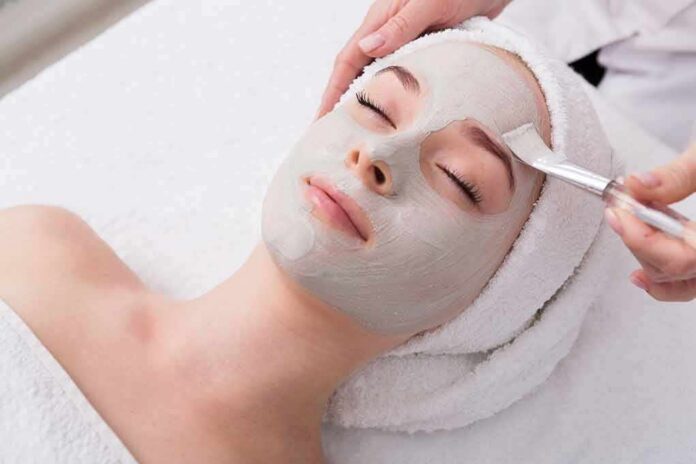
Scrubbing your face harder won’t make you look younger, it will just wreck the wall that keeps your skin healthy.
Quick Take
- Dermatologists warn that over-exfoliating and piling on too many products can damage the skin’s protective barrier.
- Daily sunscreen remains the single most proven habit for slowing visible skin aging.
- Retinoids can boost collagen production, but one clinical trial found no extra benefit over basic sunscreen and moisturizer.
- Simple routines built around gentle cleansing, moisturizing, and sun protection often beat complicated, product-heavy regimens.
The Barrier Problem Hiding In Your Bathroom Cabinet
A recent CBS News segment flagged a habit many people don’t think twice about: using too many skincare products at once. That overload can strip away the skin’s outer barrier, the thin layer that locks in moisture and blocks irritants. The American Academy of Dermatology backs this up, warning that overusing exfoliating products specifically can leave skin raw, red, and irritated instead of glowing.
This isn’t just a cosmetic inconvenience. Once the barrier breaks down, skin loses its ability to hold onto water and fend off bacteria. That shows up as dryness, stinging, and flare-ups that can take weeks to calm down. Dermatologists treat barrier damage as a foundational problem, because every other skincare goal, including collagen support and anti-aging, depends on healthy skin to begin with.
What Actually Works: Sunscreen, Retinoids, And Moisture
Sun protection remains the best-documented defense against skin aging. The American Academy of Dermatology lists daily sunscreen as a core recommendation, and a facial rejuvenation review calls it the most effective way to prevent sun-related skin damage before it starts.
Retinoids carry real scientific weight too. The American Academy of Dermatology says these vitamin A derivatives boost collagen and smooth out fine lines and uneven tone. A 2025 review found that retinoids trigger new collagen production in skin cells, and one controlled study showed a specific form, retinaldehyde, improved photoaging signs along with skin hydration.
Moisturizer plays a quieter but important role. Reviews describe daily moisturizing as a simple way to hydrate skin and reduce the look of wrinkle lines over time. Clinical skincare guides point to ceramides, a key barrier-supporting ingredient, as part of gentle routines designed to repair damaged skin rather than irritate it further.
Where The Evidence Runs Thin
Not every anti-aging claim holds up equally well under study. A randomized trial of 32 women aged 40 to 55 compared oral isotretinoin, a retinoid-related drug, against a basic routine of moisturizer and sunscreen. Both groups showed some improvement, but researchers found no meaningful difference between them.
That result matters because it challenges the idea that more aggressive treatment always beats simple, consistent care. Barrier health, visible wrinkle improvement, and actual collagen rebuilding are three different things, measured in different ways. A product that hydrates skin today isn’t necessarily rebuilding collagen underneath, and conflating the two can lead people toward routines they don’t need.
The Marketing Pressure Behind The Advice
The skincare industry has a financial stake in convincing consumers that more steps and more products equal better results. That pressure can turn a reasonable warning, like avoiding over-exfoliation, into a sales pitch for yet another serum promising to fix the damage the last serum caused. Shoppers deserve routines based on evidence, not on which brand bought the best ad placement.
Common sense still applies here. A short, consistent routine built on sunscreen, a gentle cleanser, a barrier-friendly moisturizer, and, when appropriate, a retinoid, covers the ground that matters most. Piling on extra actives in search of a shortcut risks the opposite outcome: irritated, damaged skin that takes longer to heal than it ever took to age.
Dermatology guidance keeps circling back to the same basics for a reason. They’re proven, they’re affordable, and they don’t require trusting every new product claim that shows up in a video ad. Protecting the skin barrier first gives every other anti-aging effort, from retinoids to sunscreen, an actual foundation to work on.
Sources:
youtube.com, aad.org, cbsnews.com, cvs.com, onlinelibrary.wiley.com, verywellhealth.com