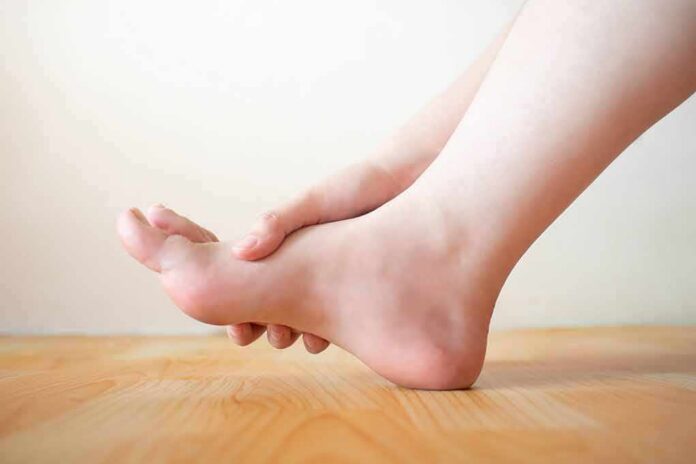
Your feet do not stop changing just because you stopped growing decades ago. New research shows adult feet can widen, flatten, and even lengthen slightly over the years, which explains why that closet full of shoes stops fitting right around middle age.
Story Snapshot
- Adult feet do not grow like a child’s feet, but their shape can shift gradually with age, according to a Time report.
- A cited study found ball-of-foot width grew 3 to 4 millimeters per decade, with circumference gains up to 7 millimeters.
- Cleveland Clinic points to worn ligaments, collapsing arches, and thinning fat pads as the main drivers.
- One study found 48 percent of adults reported at least one shoe size change after their feet finished growing, with the biggest jump between ages 50 and 64.
Why Grown Feet Still Change Shape Over Time
Most people assume their feet locked in size once they hit their twenties. That is true for bone growth. But a Time article published this month explains that the foot’s shape keeps evolving well into adulthood. The change is not about bones stretching. It is about the soft tissue and support structure around them wearing down slowly, year after year.
That wear shows up as three main shifts: feet get wider, flatter, and sometimes a bit longer. Time reports this happens “for a variety of reasons,” not from a single cause. Some people notice it in their thirties. Others do not feel it until they hit their sixties. The pattern is real, but it is not identical for everyone.
The numbers behind this claim are specific. One study cited by Time found the ball of the foot widens by 3 to 4 millimeters every decade. Ball circumference grows by 5 to 7 millimeters over the same span, and heel-instep circumference can add up to 2 millimeters. Small numbers on paper, but enough over 30 or 40 years to push a foot into a different shoe size entirely.
What Is Actually Breaking Down Inside Your Foot
Cleveland Clinic offers the clearest explanation for the mechanism. The ligaments and tendons that hold up your arch get worn down through decades of walking, standing, and running. As that support fades, the arch slowly collapses. A flatter arch spreads the foot out, making it measure longer and wider than it once did, even though no bone grew an inch.
Fat pads matter too. Cleveland Clinic notes the cushioning under your feet thins out as you age, changing how a shoe fits even if the foot’s actual dimensions barely moved. Less padding means more contact with the shoe’s interior, which can feel like a size change even when it is really a comfort change.
A peer-reviewed study in PMC backs this up with hard comparisons. Adults between 18 and 29 had noticeably smaller foot width, ball circumference, and heel circumference than older age groups tested in the same research. The data lines up with what podiatrists have observed in exam rooms for years: older feet spread out.
How Common This Change Really Is Among Adults
A study published through MDPI put real numbers on how often this happens. Forty-eight percent of participants reported at least one shoe size change in foot length after their feet had fully matured. That number jumped to 61 percent among people ages 60 to 64. The same research pinpointed ages 50 through 64 as the most active window for these changes.
Not every source agrees on every detail. One study out of northwestern Iran found foot length specifically did not change much with age, suggesting the strongest evidence points to width and shape rather than length alone. That is a reasonable caveat, not a contradiction of the bigger picture. The takeaway for anyone over 40: get your feet measured again before you buy your next pair of shoes. The size on your old box may no longer be the size on your foot.
Sources:
time.com, decentfoot.com, pmc.ncbi.nlm.nih.gov, biologyinsights.com