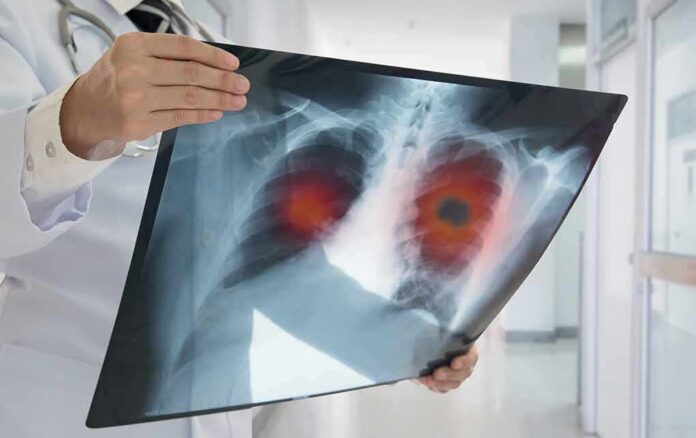
A single inherited gene flaw may explain why some people who never touched a cigarette still end up with lung cancer.
Story Snapshot
- Researchers found an inherited mutation called EGFR T790M linked to a 25-fold higher lung cancer risk overall.
- Never-smokers who carry the mutation face a risk more than 60 times higher than people without it.
- The study, from Dana-Farber Cancer Institute and the 23andMe Research Institute, appears in the journal Science.
- Only 641 carriers turned up among more than 10 million people tested, showing how rare the mutation is.
A Rare Gene Flaw Tied To Massive Risk Jump
Scientists at Dana-Farber Cancer Institute, working with the 23andMe Research Institute, identified an inherited mutation known as EGFR T790M that appears to raise lung cancer risk by 25 times overall. The study, published in the journal Science, marks one of the largest population-level looks at this kind of inherited cancer risk to date.
The number that stands out most involves people who never smoked. Among carriers who had no smoking history, the mutation was tied to a risk more than 60 times higher than in people without it, according to Dana-Farber’s announcement and reporting from Time magazine.
How Researchers Found The Pattern
The team combed through genetic and health data from more than 10 million participants, according to the Boston Globe. Out of that huge pool, they found just 641 people carrying the T790M mutation. Researchers then compared cancer outcomes among those carriers against more than 3.3 million people who reported whether they had ever had lung cancer.
That small carrier count matters. When a group is that tiny, the reported risk numbers can shift a lot with even a few added or missing cases. Still, the size of the overall dataset gives researchers a much stronger foundation than earlier family studies, which often relied on just a handful of related patients.
Smokers Are Not Off The Hook Either
The mutation did not only matter for people who avoided tobacco. Dana-Farber’s release found that smokers carrying the mutation faced roughly 10 times the lung cancer risk of noncarriers, and Time reported the overall 25-fold risk held regardless of smoking status. That suggests the gene itself drives much of the danger, with smoking adding further risk on top of it.
Earlier Science Already Pointed This Direction
This is not the first time doctors have connected inherited EGFR mutations to lung cancer in nonsmokers. Peer-reviewed research published earlier found that never-smokers carrying germline EGFR T790M developed lung cancer more often than smokers who lacked it. A 2023 review of families affected by inherited lung cancer found that 50 of 91 confirmed carriers eventually developed the disease.
What makes the new Science study different is scale. Older research relied on tracking individual families through generations, a slow and limited method. The new project used a massive consumer genetic database, letting researchers spot a rare mutation across millions of unrelated people instead of just a few kindreds.
What The Public Reporting Does Not Yet Show
The available announcements and news coverage give the headline numbers, but not every technical detail behind them. Confidence intervals, the exact statistical model, and how researchers accounted for other risk factors are not laid out in the material released so far. That is a normal early step in how big genetic studies reach the public before the full paper’s methods are scrutinized by other scientists.
It also is not yet clear from public materials whether every cancer case counted involved confirmed tumor testing in addition to the inherited gene test. That distinction affects how tightly researchers can link the inherited mutation to the actual disease process rather than just a statistical pattern.
Why This Discovery Could Matter For Families
Lung cancer already kills more Americans than any other cancer, and a growing share of cases occur in people who never smoked. A confirmed inherited risk marker like T790M could eventually allow doctors to screen at-risk family members earlier, long before symptoms appear. That kind of early warning has already reshaped care for other inherited cancer genes, including BRCA mutations tied to breast cancer.
For now, the mutation remains extremely rare, and no public health agency has issued new screening guidance based on this single study. But the scale of the research, backed by one of the country’s leading cancer institutes and a massive genetic database, gives the finding real weight heading into further review and replication by outside scientists.
Carriers of the EGFR T790M mutation have a 25-fold higher risk of lung cancer regardless of smoking, and among nonsmokers the risk jumps to 60-fold: a signal strong enough that the data, drawn from 23andMe’s large genetic repository, now allows population-level risk estimates for…
— NewsWhat (@NewsWhatHQ) September 17, 2026
Families with a history of lung cancer among nonsmokers now have a concrete genetic lead worth discussing with a doctor. The discovery does not change how cancer is treated today, but it adds a real data point to a mystery that has puzzled oncologists for years: why people who did everything right still get sick.
Sources:
time.com, dana-farber.org, sharjah24.ae, pmc.ncbi.nlm.nih.gov