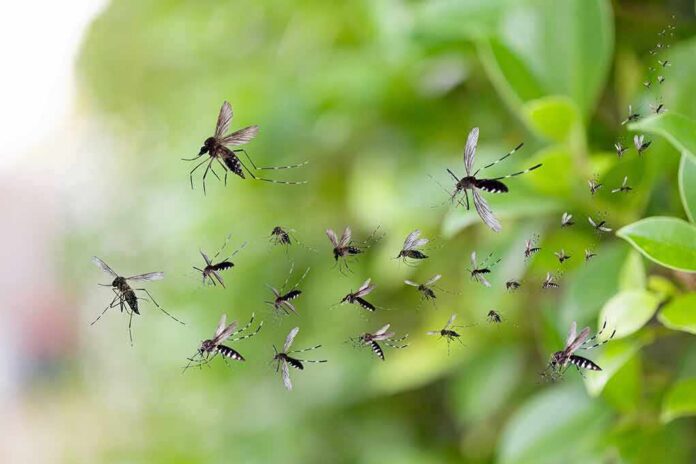
A four-year study in Brazil found that lab-bred mosquitoes cut dengue and chikungunya infections in children by 69%.
Story Snapshot
- Researchers tracked more than 5,700 children in Belo Horizonte, Brazil, for four years.
- Neighborhoods with Wolbachia-carrying mosquitoes saw 69% fewer dengue and chikungunya infections.
- The effect held even during Brazil’s severe 2024 dengue outbreak.
- An earlier Niterói study found a similar 69% drop in dengue cases.
- A larger review of nine studies covering over 8 million people found even bigger average reductions.
A Four-Year Trial Brings Strong New Results
Scientists ran a study called EVITA in Belo Horizonte, a large city in southeastern Brazil. They released mosquitoes carrying a bacteria called Wolbachia into chosen neighborhoods. The bacteria does not harm the mosquitoes, but it blocks viruses like dengue and chikungunya from growing inside them. Children living in these areas got sick with dengue and chikungunya 69% less often than kids in similar neighborhoods without the mosquitoes.
The team behind the study included Brazil’s Ministry of Health along with researchers from Emory University, Yale University, and the U.S. National Institute of Allergy and Infectious Diseases. Dr. Sri Edupuganti, one of the lead researchers, said the protection lasted even during 2024, when Brazil suffered one of its worst dengue outbreaks in years. That timing matters because it shows the mosquitoes kept working under real-world pressure, not just in ideal conditions.
Earlier Work Pointed to the Same Pattern
This is not the first time scientists have seen this kind of result. A 2021 study in Niterói, a city near Rio de Janeiro, also found a 69% drop in dengue cases after Wolbachia mosquitoes were released there. That study compared infection rates with a specific control area and reported a confidence range of 54% to 79%, meaning the true effect was very likely somewhere in that band. Researchers called it a “quasi-experimental” study because it did not randomly assign which neighborhoods got the mosquitoes.
The Belo Horizonte trial improves on that design by randomly assigning neighborhoods, which helps rule out other explanations for the drop in cases. Findings from both studies were shared at the American Society of Tropical Medicine and Hygiene’s annual conference in November. Brazil’s Fiocruz institute, a major public health research center, also confirmed the 69% figure and noted it marks the first strong evidence that the method protects against chikungunya specifically, not just dengue.
How This Fits a Bigger Global Pattern
Brazil is not alone in testing this approach. A cluster-randomized trial in Yogyakarta, Indonesia, found an even bigger effect, a 77% drop in confirmed dengue cases among more than 6,300 people. The Cochrane group, which reviews medical evidence worldwide, rated that finding as “moderate certainty,” though it noted the result came from just one trial. A 2026 review pooling nine studies and more than 8 million people estimated an even larger average reduction, though the range of results varied depending on location and study design.
That variation matters. Reductions of 69%, 77%, and even higher figures from a broader pooled analysis all point the same direction, but the exact number shifts based on how a study is built and where it happens. Factors like local mosquito populations, weather, and how closely researchers track cases all affect the outcome. Still, every major study reviewed so far has found a meaningful drop in disease, not a weak or random effect.
Why This Matters Beyond Brazil
Dengue sickens tens of millions of people every year across tropical regions, and chikungunya causes painful, sometimes long-lasting joint pain. Both diseases spread through the same mosquito species, Aedes aegypti, which also carries Zika. A method that cuts infections by roughly two-thirds in real neighborhoods, sustained through a bad outbreak year, offers health officials a rare tool that does not rely on pesticides or require a vaccine for every person.
Mosquitoes Bred to Carry Bacteria Sharply Cut Dengue in Brazil Trial pic.twitter.com/Nac0ZRRjdJ
— NewsPlain (@newsplainapp) November 22, 2026
The World Mosquito Program, which runs similar projects in multiple countries, has said the method can be cost-saving at a large scale in high-density cities. Brazil’s results add fresh backing to that case, built on years of tracking real children in real neighborhoods rather than lab models. For families living with the yearly threat of dengue season, the data offers a concrete, measurable sign of progress.
Sources:
youtube.com, goodbad.day, pmc.ncbi.nlm.nih.gov, wusf.org, medrxiv.org, aljazeera.com, academic.oup.com, tandfonline.com