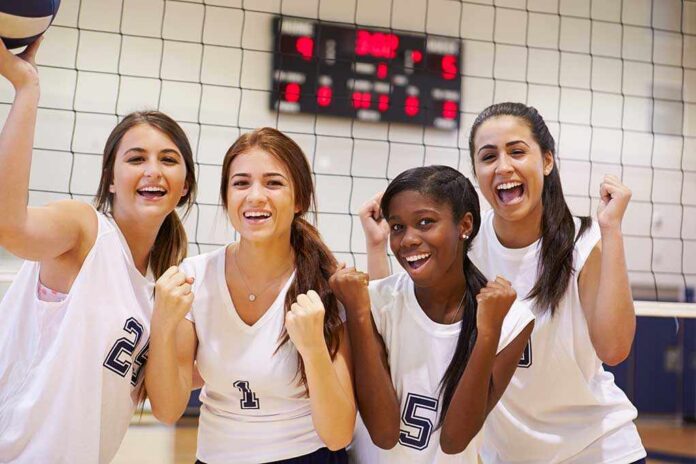
Millions of girls step onto fields and courts every season with bodies that work differently than their male teammates, yet most coaches never learned how to train around that difference.
Quick Take
- Only 9% of female high school varsity athletes are required to do neuromuscular training that helps prevent ACL tears, compared with 50% of male athletes.
- Doctors warn that ignoring menstrual irregularity in athletes can lead to weak bones, depression, anxiety, and eating disorders.
- Women make up just 24% of head coaches across FIFA Women’s World Cup history and under 20% of coaches in many other organizations.
- Swiss research found 45% of coaches never track athletes’ menstrual cycles, and only 10% actively plan training around them.
The Hidden Physiology Gap in Youth and Elite Coaching
Doctor Kate Ackerman, a leading voice on female athlete health, explains that prolonged low energy intake can trigger a chain reaction. Menstrual cycles stop. Bones weaken. Depression and anxiety creep in. She says many clinicians still tell athletes that missed periods are harmless or fixable with birth control alone, a message that misses the deeper warning sign. Doctors who study female athletes point to a pattern called RED-S, short for Relative Energy Deficiency in Sport. It happens when athletes burn more energy than they take in for too long. Doctor Kate Ackerman has explained that this can cause missed periods, weak bones, anxiety, and depression.
The injury-prevention gap tells a similar story. A 2023 study found only 9% of female high school varsity athletes must complete neuromuscular training designed to protect their knees, while half of male athletes do. Girls tear their ACLs at far higher rates than boys, yet fewer than half of college athletes have even received basic education on the injury or how to avoid it.
Why Female Coaches Are Rare and What It Costs Athletes
Part of the problem traces back to who is standing on the sideline. Women held only 24% of head coaching jobs across every edition of the FIFA Women’s World Cup, and the sport’s global governing body says women make up just 5% of all registered soccer coaches worldwide. Women in Sport’s 2026 report found representation stuck below 20% across many coaching roles.
That gap matters more than it might seem. A large Scandinavian survey of over a thousand female athletes found most rated their own and their coaches’ knowledge of the menstrual cycle as poor or very poor. Athletes also said they found female coaches easier to talk to and more knowledgeable about these issues than male coaches. Fewer women in coaching means fewer athletes get that comfort.
The Distance Between Good Intentions and Daily Practice
Coaching guidance already exists. One widely used training document tells coaches to speak plainly about periods and premenstrual symptoms, and to have athletes log their cycles alongside training data to spot patterns. The advice is sound. The problem is how rarely it gets used.
Swiss researchers surveyed coaches directly and found real willingness to learn, but a wide gap in action. Nearly half never tracked athletes’ menstrual cycles at all, and only one in ten actively planned training around it. Coaches blamed lack of knowledge, thin coverage in certification courses, and no practical tools to work with.
A German study of sports clubs found the same disconnect: coaches rarely bring up the menstrual cycle even though many female athletes say they would welcome the conversation. A larger review pulling data from over 7,500 athletes and coaches found taboo, missing knowledge, and poor communication as the biggest barriers, while trust and simply having female coaches around helped close the gap. The evidence points to a fixable problem. Coaches are not villains here. Most want to help. What is missing is training, tools, and a culture that treats a girl’s biology as a normal coaching subject, not an awkward one.
Sources:
womenssportsfoundation.org, tandfonline.com, journals.sagepub.com, semanticscholar.org, pmc.ncbi.nlm.nih.gov, podcasts.apple.com, public-pages-files-2025.frontiersin.org