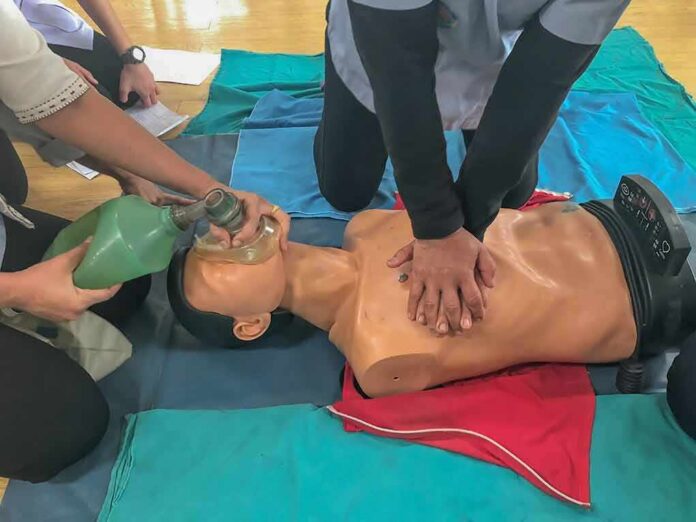
A kid who knows CPR can double a stranger’s odds of walking out of a hospital alive, yet most American students graduate without ever practicing it on a dummy.
Quick Take
- Bystander CPR nearly doubles survival after sudden cardiac arrest, but fewer than half of adult victims get it.
- Schools reach almost every child, making them a natural place to teach a skill that saves lives.
- States with CPR graduation laws report higher rates of bystander CPR and AED use.
- Money, not willpower, is the biggest obstacle standing between policy and practice.
The Survival Math Nobody Disputes
When someone’s heart stops outside a hospital, the clock becomes the enemy. The American Heart Association reports that witnessed arrests where a bystander performed CPR had a 13 percent survival rate to hospital discharge, compared with 7.6 percent for those left untreated. Yet only 41.7 percent of adult victims received that help at all. That gap between what works and what happens is the entire argument for teaching CPR in school.
Why Schools Make Sense as the Delivery System
Kids show up to class. Attendance compliance runs 97.4 percent for ages 5 to 14 and 76.5 percent for teens 15 to 19, according to an American Heart Association scientific statement. No other institution touches that many young people on a predictable schedule. States that already require high school CPR training have seen higher rates of bystander CPR and AED use in their communities, suggesting the classroom pipeline actually changes behavior once students graduate into the real world.
Denmark offers the clearest real-world test case. After the country mandated CPR instruction in elementary schools and driver’s education, bystander CPR rates climbed from about 21 percent in 2001 to nearly 45 percent by 2010, while survival more than tripled over the following years. A separate Danish study of over 51,000 cardiac arrests found that a five-point rise in annual basic life support course participation tracked with a 14 percent jump in 30-day survival. The pattern is not theoretical.
Where the Case Gets Harder to Sell
None of this proves that a single mandatory classroom unit, by itself, causes better outcomes. The data linking state laws to higher bystander CPR rates is observational, meaning states with strong training laws might also have better ambulance systems or more public health funding already in place. Critics are right to note that correlation is not the same as a guaranteed cause and effect, even when the trend lines look convincing.
Cost is the real fight, and it is a fair one. New York estimated an average district of 3,000 students could implement training for about $3,054 upfront and $1,392 a year after that, with a statewide price tag near $2.7 million initially. That sounds manageable until you remember Iowa made CPR a graduation requirement in 2011 without sending districts a dime to pay for it, leaving schools to scrounge for manikins and trained instructors on their own.
Good Intentions Without a Checkbook
Colorado tried a softer approach in 2023, encouraging CPR training in high schools without requiring it and without funding it. The state’s school executives association argued districts should set their own priorities while juggling tight budgets, and critics called the bill a feel-good gesture with no teeth. That tension, encourage versus mandate, funded versus unfunded, is where most state CPR policy actually lives, and it explains why national progress has been slow and uneven.
Rhode Island schools surveyed on the subject pointed to the same three walls every time: not enough instructional time, not enough budget, and not enough practice manikins to go around. Those are solvable logistics problems, not philosophical objections. A state willing to treat CPR training like fire drills, with dedicated funding and recurring practice rather than a one-time lecture, could close the gap without reinventing the wheel.
A Skill Worth Funding Properly
The evidence says trained bystanders save lives, schools are the most efficient place to train them, and the obstacles are financial and logistical rather than scientific. Lawmakers who pass CPR mandates without paying for manikins, instructors, or refresher drills are setting schools up to fail quietly. If this skill is worth requiring, it is worth funding like any other graduation requirement, not tacking it on as an unpaid afterthought and calling it progress.
Sources:
time.com, cpr.heart.org, legis.la.gov