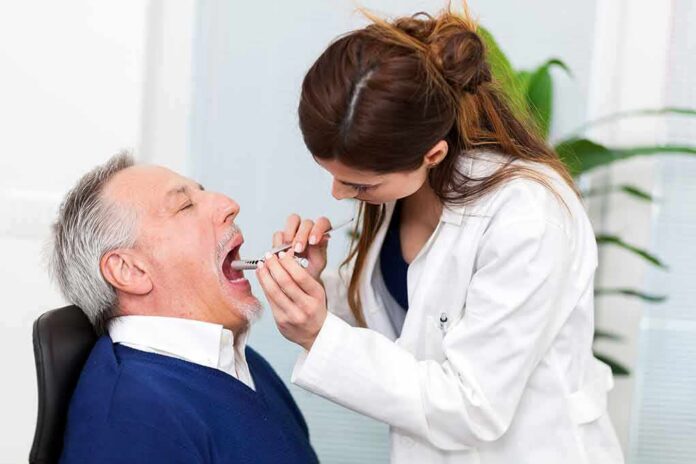
A sore spot in your mouth that refuses to heal after two weeks is one of the clearest warning signs doctors want you to know about oral cancer.
Quick Take
- Oral cancer can form on the lips, tongue, gums, cheek lining, floor of the mouth, and roof of the mouth.
- Warning signs include sores that won’t heal, strange bleeding, swelling, white or red patches, and trouble chewing or swallowing.
- Tobacco and alcohol use, especially together, dramatically raise your risk.
- Health videos on platforms like YouTube reach huge audiences, but research shows the most-watched content isn’t always the most accurate.
Where This Cancer Actually Grows
Oral cancer is not one single thing. It can start in several specific spots inside your mouth. The National Cancer Institute lists the lips, the front two-thirds of the tongue, the gums, the inside lining of the cheeks, the floor of the mouth, and the hard palate as the main sites. Knowing these locations matters because treatment and outlook can differ depending on exactly where a tumor begins.
Doctors also separate oral-cavity cancer from oropharyngeal cancer, which forms farther back near the base of the tongue and upper throat. The Centers for Disease Control and Prevention (CDC) treats these as distinct categories, even though both get lumped into everyday conversations about “mouth cancer”. That distinction shapes how doctors screen patients and choose treatment paths.
The Signs You Should Never Ignore
A sore that won’t heal, unexplained bleeding, swelling, or a lump are all signals worth a dentist’s attention. So are white or red patches on the gums, tongue, or cheek lining, along with pain or difficulty chewing and swallowing. The CDC and National Cancer Institute both list these symptoms as possible warning signs of oral or head-and-neck cancer. None of these symptoms alone prove cancer, but each one is reason enough to get checked.
A proper diagnosis almost always requires a hands-on exam by a dentist, oral specialist, or physician. In many cases, a biopsy is the only way to know for certain what’s really happening. Spotting a symptom at home is step one. Letting a trained professional look closer is the step that actually matters.
Tobacco, Alcohol, and the Math Behind the Risk
Smoking changes the odds dramatically. The National Cancer Institute reports that people who currently smoke face roughly five to ten times higher risk of oral cancer compared with people who never smoked. Combine tobacco with heavy drinking and the risk climbs even further, since the two substances amplify each other’s damage to the cells lining the mouth. This is one of the most well-documented prevention messages in all of oncology, and it applies regardless of age or background.
How Online Video Is Changing the Way People Learn About Cancer
Millions of people now turn to video platforms before they ever call a doctor’s office. That shift has real upside. It puts medical information in front of people who might otherwise skip a checkup entirely. But researchers studying medical content online have found a troubling pattern: engagement-driven platforms can reward dramatic or oversimplified videos over careful, accurate ones.
A study looking specifically at lung cancer videos on YouTube found that around two-thirds offered useful patient education, while the misleading videos actually pulled in more viewer interaction. That mismatch between popularity and accuracy is worth keeping in mind for any health topic, oral cancer included. A video can be well-produced and still skip over important distinctions, like the difference between a benign lesion and an actual malignancy.
None of this means viewers should distrust every health video they come across. It means viewers should treat video content the way they’d treat a tip from a friend: useful for raising awareness, not a substitute for a professional exam. The core facts about oral cancer, where it forms, what symptoms to watch, and how tobacco and alcohol raise risk, are well established by federal health agencies. The responsibility now falls on viewers to pair that awareness with an actual appointment.
For anyone noticing a sore, patch, or swelling that lingers past two weeks, the message from health agencies is simple and consistent. Don’t wait, don’t self-diagnose from a screen, and don’t assume it’s nothing. Get it looked at by someone trained to tell the difference between a minor irritation and something far more serious.
Sources:
youtube.com, nidcr.nih.gov, cancer.gov, academic.oup.com