Heavy legs, nighttime cramps, and swollen ankles usually trace back to one simple problem: blood struggling to climb back up to your heart.
Quick Take
- Doctors and major health systems agree that movement, not rest, is the best medicine for poor leg circulation.
- Compression socks and leg elevation help push blood back toward the heart instead of pooling in the lower legs.
- Calf raises and ankle pumps work like a second heart, squeezing veins to keep blood flowing.
- Smoking cessation and hydration round out the lifestyle habits clinicians consistently recommend.
Why Your Legs Suffer When You Sit Too Long
Blood has to fight gravity to travel from your ankles back up to your chest. Veins rely on muscle squeezes and one-way valves to make that climb. Sit or stand still for hours, and that pump shuts off. Cleveland Clinic warns against prolonged sitting or standing and tells people to get up and walk around throughout the day to keep blood moving.
This isn’t niche advice buried in a textbook. It shows up again and again across major health systems, which is exactly why it carries weight. When Cleveland Clinic, Mayo Clinic, and Vanderbilt Health all land on the same core habits, that consistency itself is the story.
Walking Still Beats Almost Everything Else
Exercise ranks as the single most repeated recommendation for leg circulation. WebMD calls physical activity “one of the best ways to improve your circulation,” noting that even simple stretching helps blood move. Low-impact options like walking or pool therapy work especially well because they engage the calf muscles without straining joints, making them realistic for people managing arthritis or older age. National heart guidelines back this up at a clinical level, too. Structured walking programs are treated as frontline therapy for serious circulation problems like peripheral artery disease, not just a wellness suggestion for tired legs. That matters for everyday readers because it confirms walking isn’t a soft recommendation. It’s the same tool doctors reach for in diagnosed vascular disease.
The Calf Pump, Compression, and Elevation Trio
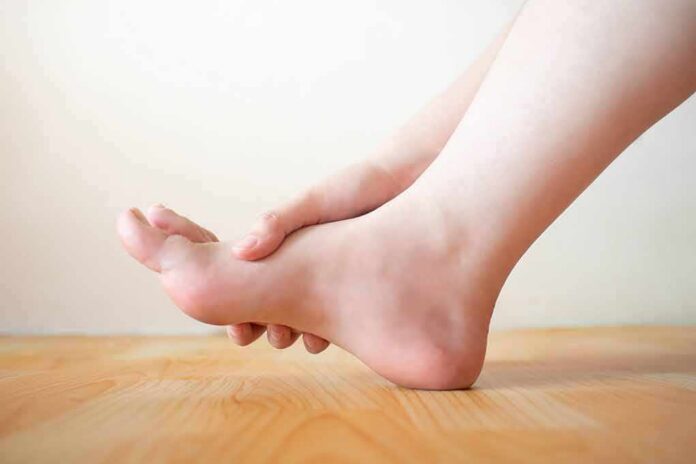
Your calf muscles act as a built-in pump for your lower legs. Every contraction squeezes veins and forces blood upward. Vanderbilt Health specifically recommends pumping the calf muscles and doing ankle pumps to mimic that same motion when you can’t walk. Simple moves like pointing and flexing your toes while seated on a plane or at a desk use this same mechanism. Compression socks support that pump from the outside. WebMD explains that the socks gently squeeze the legs so blood doesn’t linger too long before heading back toward the heart. Mayo Clinic adds a third tactic: raising your legs above heart level for a few minutes several times a day to help gravity do the opposite of its usual job.
Smoking, Hydration, and Breaking Up Long Stretches of Stillness
Smoking damages blood vessels directly, which is why WebMD and Vanderbilt Health both list quitting as a core circulation strategy. Staying hydrated keeps blood at a healthier consistency, making it easier to move through narrow vessels. None of this is complicated. It’s the kind of unglamorous daily discipline that actually moves the needle on a chronic, often ignored problem.
What the Full Picture Tells Us
No single doctor-authored checklist produced these seven habits as one official list. They’re assembled from overlapping guidance across trusted health systems, which is actually reassuring. When Cleveland Clinic, Mayo Clinic, WebMD, and Vanderbilt Health independently arrive at the same handful of habits, that’s consensus built from repetition, not a marketing gimmick. Walk more, move your calves, elevate your legs, wear compression gear, quit smoking, and drink water. Simple, repeatable, and backed by the people who treat circulation problems every day.
For anyone over 40 noticing heavier legs at the end of the day, these aren’t lifestyle luxuries. They’re low-cost, low-risk habits with real clinical backing, worth building into a daily routine before small aches turn into bigger vascular problems.
Sources:
youtube.com, health.clevelandclinic.org, webmd.com, my.clevelandclinic.org, scienceinsights.org